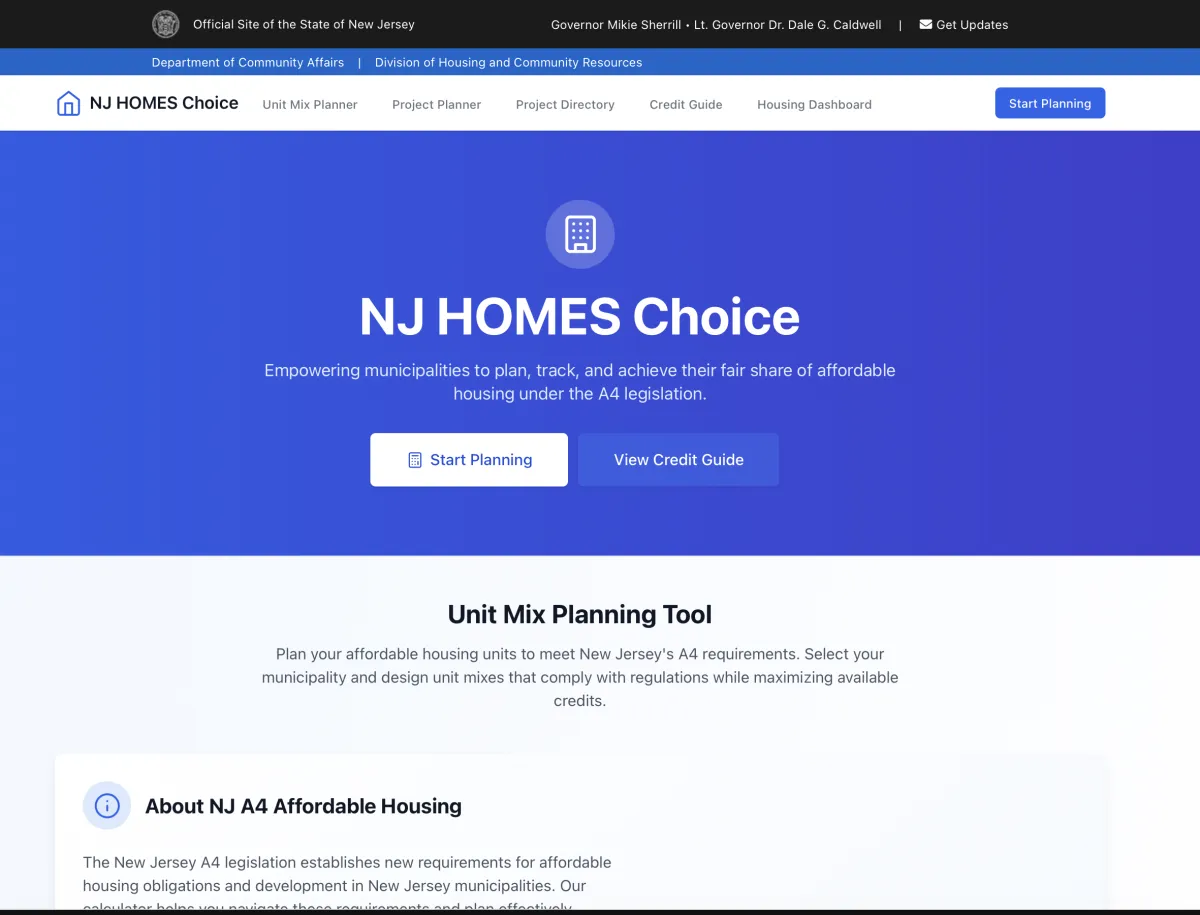
NJHOMES Choice Tool
Interactive planning tool implementing A4/S50 affordable housing calculations for all 564 municipalities, now extended by the NJHOMES Atlas statewide vacant land inventory.
The Problem
When A4/S50 established new affordable housing requirements for all 564 New Jersey municipalities, local officials faced an immediate challenge: how to understand their obligations and plan accordingly. The legislation created a new calculation methodology, but no tools existed to help towns apply it to their specific circumstances.
DCA needed a way to support the first cohort of NJHOMES grantees while helping all municipalities understand their prospective need numbers under the new framework.
What I Built
Working with DCA’s policy teams, I developed an interactive planning platform that implements A4/S50 calculations for every municipality. The tool lets officials simulate different development scenarios, understand how various project types contribute to their obligations, and track progress over time.
The core features include a unit mix planner for modeling development scenarios, a credit calculator that applies the specific A4/S50 methodology, and a project tracker for monitoring municipal progress. A directory of Affordable Housing Trust Fund and National Housing Trust Fund projects gives towns visibility into available funding opportunities.
The interface prioritizes local control. Officials can select projects that fit their community’s character rather than accepting top-down mandates. This design choice reflected a core policy goal: municipalities should understand their obligations and have tools to meet them on their own terms.
Impact
The tool supported the grantmaking process for the first NJHOMES cohort, providing consistent calculations and planning capabilities across participating municipalities. With all 564 towns now able to access the same methodology and modeling tools, officials can figure out where they stand before enforcement becomes an issue.
The platform reduced what would have been hundreds of individual technical assistance requests into self-service functionality. Municipal planners who previously relied on consultants for basic obligation calculations can now run scenarios themselves.
NJHOMES Atlas
In 2026 the platform picked up a second job. The federal 21st Century ROAD to Housing Act requires every municipality that takes housing block grant money to publish an online, searchable list of the vacant land it owns by October 1, 2026, and that includes land a town holds outside its own borders. The law does not say how, and no funding came with it.
NJHOMES Atlas answers it inside the tool towns already have. It maps municipally owned vacant land across all 564 municipalities using State property tax assessment records, which are the only source that describes every town on the same terms. The current count runs to roughly 42,000 vacant parcels and about 110,000 acres, grouping into somewhere near 27,000 contiguous sites that could actually be built on.
Assessment records go stale, so the State list is where a municipality starts rather than where it ends. Each town corrects its own entries from local knowledge, every correction records a reason and a name, and the corrected version is what the town publishes and embeds on its own website. That leaves a documented trail a municipality can show the federal government.
DCA offers Atlas at no cost, with technical assistance for towns working through the requirement. The Department announced it on October 2, 2026, and the release quotes me on why it was built. I’ve posted notes on the release here. The alternative was about a dozen cities each procuring a separate vendor and producing a dozen lists that could not be compared to one another.
Watch the Webinar
On September 24, 2026, I walked mayors and legislators through Atlas in a DCA Mayors and Legislators Resource Series webinar, co-presented with Lucas Doell, the Data Center’s software engineering team lead. The recording and session notes cover the federal requirement, how the parcel inventory is assembled, and the municipal correction workflow. Atlas and NJHOMES Choice were then presented together at the Governor’s Conference on Housing and Economic Development in Atlantic City on September 29 and 30; those slides are posted as well.
This project is part of Gavin Rozzi's extensive work serving the Garden State.
About the Author
