The Real Cost of NIMBY: The Economic Development Case for Affordable Housing

I joined a panel at the 30th annual Governor’s Conference on Housing and Economic Development at Harrah’s Resort in Atlantic City, presenting in my role as Director of the DHCR Data Center on the data tools the NJ Department of Community Affairs has developed to help communities make the economic case for affordable housing.
Session Details
The Real Cost of NIMBY: The Economic Development Case for Affordable Housing September 29, 2026, 4:00–5:15 PM — Wildwood 20/21
From the conference program: affordable housing brings a variety of benefits — not just for the families who will live there, but for communities and the State. The session covered the research on the economic benefits of investing in affordability and how DCA has developed data tools that can help make the economic case for developing affordable housing.
What I Presented
My portion of the panel was titled Moving Beyond NIMBY with Data, and the argument was that a lot of local opposition starts as an information problem. Affordable housing rules are genuinely complicated — obligations, credits, income tiers, unit mix requirements — and residents rarely get to see their own town’s obligation, what has already been built there, or what options the town actually has. When the process is that hard to follow from the outside, assumptions fill the gap, and an assumption that settles in early is hard to correct later.
The picture people carry is large, high-density complexes in every town. The project directory shows something else. Two family rental units in Rumson Borough. Ten senior units in Millstone Township. Fifty-nine senior units in a converted hotel in Jersey City. A town can browse the directory and save the projects that would plausibly fit it.
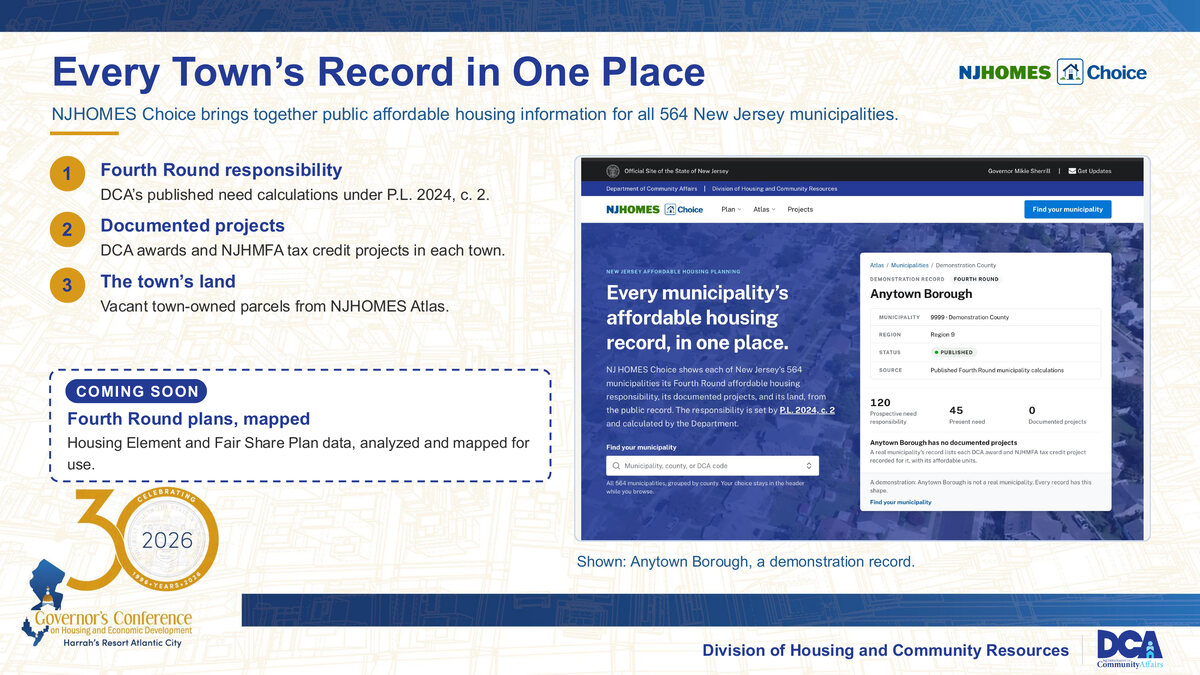
NJHOMES Choice gathers each municipality’s record into one place: its Fourth Round responsibility under P.L. 2024, c. 2, the DCA awards and NJHMFA tax credit projects documented for it, and its own vacant land from Atlas.
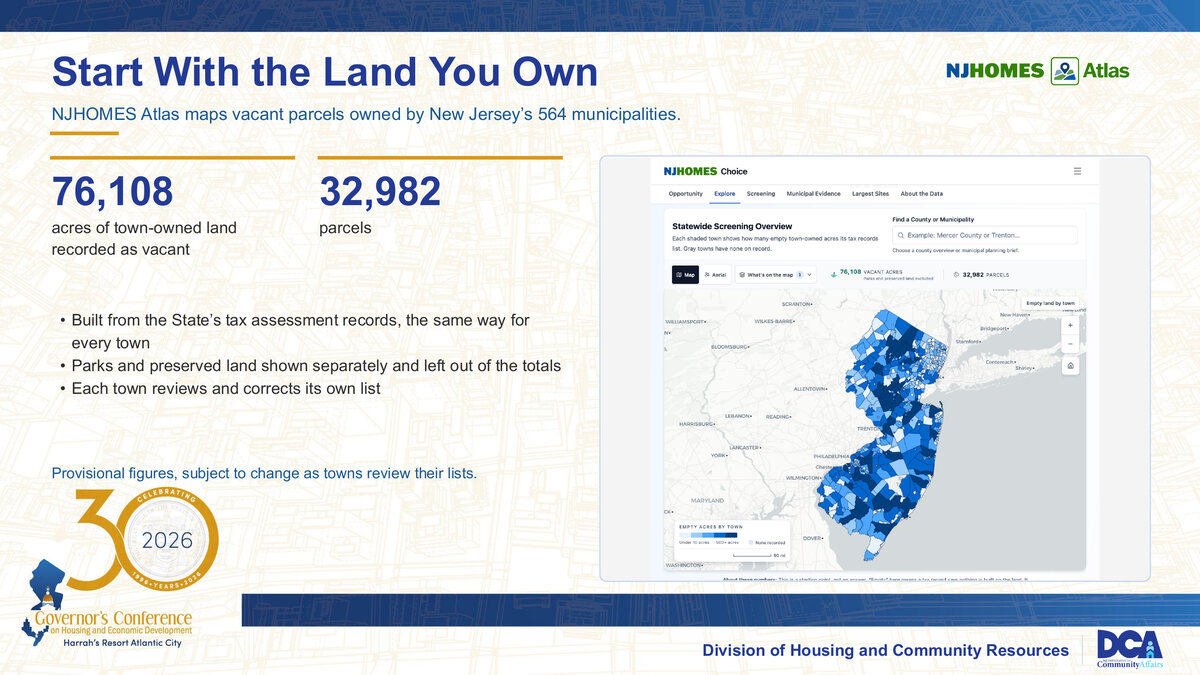
Atlas maps the vacant parcels owned by New Jersey’s 564 municipalities, built from the State’s tax assessment records the same way for every town, with parks and preserved land shown separately and left out of the totals. Each town reviews and corrects its own list, so the statewide figures are provisional and move as that review goes on.
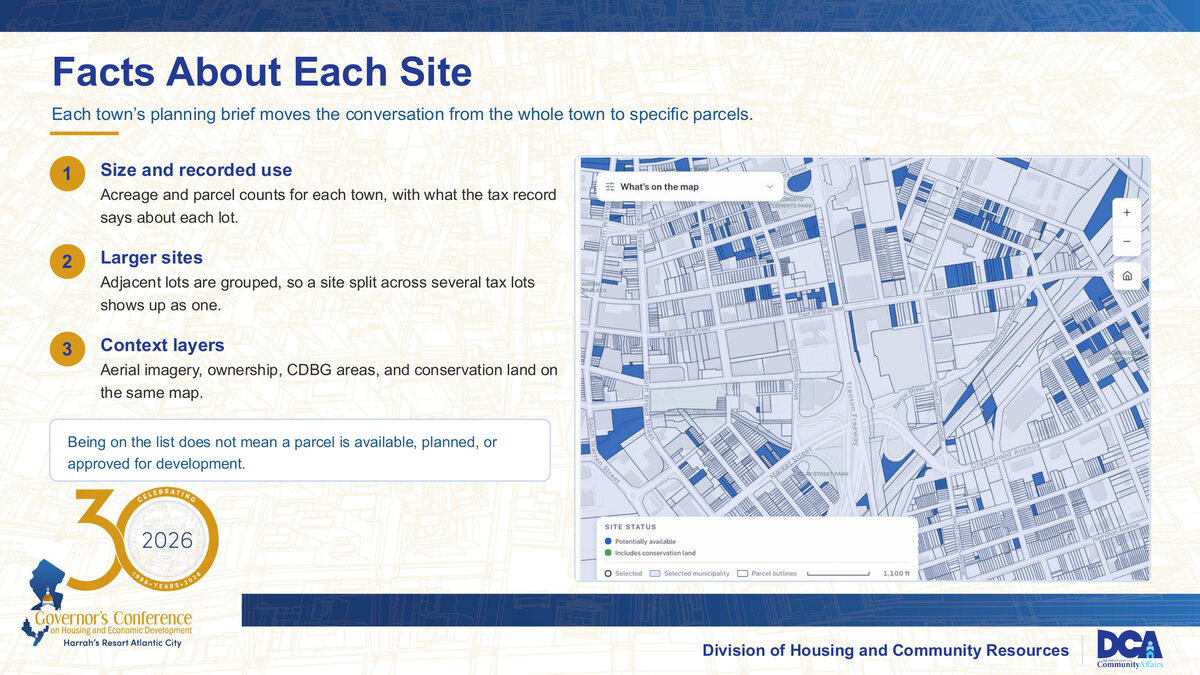
From there each town’s planning brief moves the conversation down from the whole municipality to specific parcels — size and recorded use, adjacent lots grouped so a site split across several tax lots reads as one, and context layers for aerial imagery, ownership, CDBG areas and conservation land. Being on that list does not mean a parcel is available, planned, or approved for development.
The point underneath all of it is that towns, residents and developers working from the same information is a better starting point than arguing over whose numbers are right.
Panel Participants
Colleen Velez (Moderator) — Division of Housing and Community Resources, NJ Department of Community Affairs
Helen Kioukis — Policy Manager, Housing and Land Use, NJ Future
Gavin Rozzi — Director, Division of Housing and Community Resources Data Center, NJ Department of Community Affairs
Christopher Wheeler, PhD — Chief Data Officer, NJ Department of Community Affairs
A representative of The Reinvestment Fund was also slated to join the panel.
NJHOMES Atlas at the Conference
DCA promoted NJHOMES Atlas across both days of the conference, September 29 and 30, with live demos at the DCA data booth. Atlas is the statewide map of municipally owned vacant land built into the NJHOMES Choice Tool, and it exists so that Community Development Block Grant recipients can publish the searchable inventory the federal 21st Century ROAD to Housing Act required of them as of October 1, 2026.
Conference Context
2026 marks the 30th anniversary of the Governor’s Conference on Housing and Economic Development, New Jersey’s largest annual gathering of housing and economic development professionals. Governor Mike Sherrill was slated to deliver the keynote address.
Resources
About the Author
